No country on earth is more intimately intertwined with the art of watchmaking than Switzerland. The Jura region alone has produced, over three centuries, a concentration of horological talent and institutional knowledge that remains unmatched anywhere in the world. To collect watches in Switzerland is not simply to acquire objects — it is to participate in a living tradition, to become a custodian of something that has taken generations to build.
This article is about the culture of watch collecting in Switzerland: where it came from, how it is practised today by the most serious collectors in Geneva and Zurich, what serious Swiss collectors value, and what the responsibility of collecting — of custody — actually means at the level where it matters most.
Swiss watchmaking's origins lie in the religious refugees of the sixteenth century — Huguenots fleeing France who brought their craft knowledge to the Calvinist cities of Geneva and Neuchâtel. Within two generations, Geneva had become the pre-eminent centre of fine watchmaking in the world. Abraham-Louis Breguet, operating in the late eighteenth and early nineteenth centuries, produced work of a technical and aesthetic sophistication that remains unsurpassed — the tourbillon, the self-winding mechanism, the perpetual calendar — and established the benchmark against which all subsequent watchmaking has been measured.
The twentieth century brought both crises and triumphs. The quartz revolution of the 1970s nearly destroyed the traditional mechanical watch industry, and it was the remarkable story of the Swatch Group and the Swiss industry's reinvention of itself as a luxury goods sector that saved it. Today, Swiss watchmaking produces approximately 10% of the world's watches by volume and more than 50% by value — a statistic that captures the extraordinary concentration of premium quality that the Swiss tradition represents.

The serious collector community in Switzerland gravitates around two poles: Geneva, home of the Salon International de la Haute Horlogerie (SIHH, now Watches and Wonders), Christie's and Sotheby's Geneva watch departments, and the private rooms of Patek Philippe, A. Lange & Söhne, and Audemars Piguet; and Zurich, Switzerland's largest city, financial capital, and home to a dense, discreet community of collectors whose collections are rarely photographed and almost never publicised.
The culture in both cities is characterised by a preference for knowledge over spectacle. A serious Swiss collector is more interested in movement architecture than in celebrity associations, more focused on condition and provenance than on market value, and deeply sceptical of the hype cycles that drive collecting in less discerning markets. The Patek Philippe 5970 that appears at Christie's Geneva and sells for double its estimate typically belongs to a Swiss collector who has owned it for twenty years and is parting with it reluctantly, not to a speculator who acquired it eighteen months ago.
Provenance is the first priority of the serious Swiss collector. A watch with an unbroken ownership history — ideally including the original box, papers, and service documentation — commands a premium not merely because it is more valuable at auction, but because it represents something complete: a fully documented object with an authentic story. The watch as a biographical object, bearing evidence of the hands through which it has passed and the time it has marked, is what distinguishes a collection from a portfolio.
Condition is the second priority. Swiss collectors understand that a watch that has been over-polished — its case angles softened, its brushed surfaces made uniformly shiny by a machine — is permanently damaged. They prefer original condition, with honest wear and patina, to the artificial freshness of over-restoration. This is a sophisticated position that takes years of collecting to fully internalise, and it is one reason why the best Swiss collections often look slightly less impressive at first glance than they are in reality.
Rarity and technical interest round out the priorities. Reference numbers matter. Production quantities matter. Calibre specifications matter. A collector who cannot speak fluently about the movement inside a watch they own is not, by the standards of serious Swiss collecting, a collector at all — they are merely an owner.
The financial dimension of watch collecting has become impossible to ignore. Certain references — the Patek Philippe 5711, the Audemars Piguet Royal Oak 15202, the Rolex 'Paul Newman' Daytona — have appreciated at rates that compare favourably with traditional asset classes over any meaningful period. The Watch Fund, various auction indices, and specialist advisors now treat watches as a legitimate alternative asset category alongside art, wine, and classic cars.
The serious Swiss collector tends to be ambivalent about this development. The financialisation of the market has driven prices to levels that make acquiring certain references extremely difficult, and has introduced a speculative element — flipping, grey market dealing, investment-led buying — that sits uncomfortably with the collecting tradition's emphasis on knowledge, patience, and custody. The collector who buys a watch to sell it in eighteen months is not a collector. The collector who owns a watch for thirty years and considers its financial value only when writing their estate documents — that is the tradition Switzerland produces and values.
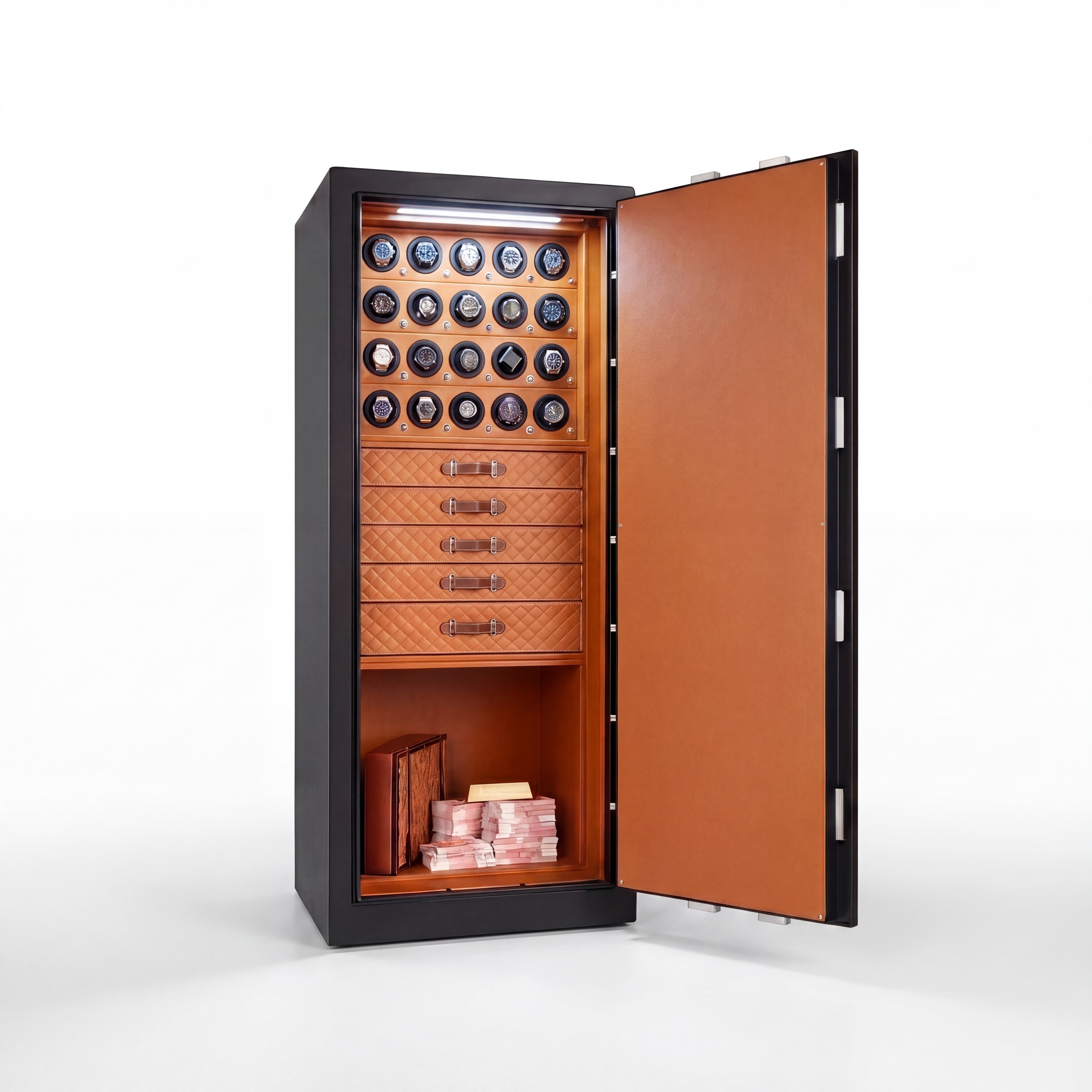
Collecting watches in Switzerland comes with an implied responsibility that the most serious collectors articulate clearly: you are a custodian, not an owner. The watch will outlast you. Its next owner will judge you by the condition in which you kept it — the regularity of its service intervals, the care you took with its case, the quality of its storage. A watch kept in a proper safe, wound correctly, serviced on schedule, and stored in consistent conditions is a watch that can be passed to the next generation in better condition than you received it. This is the standard to which Swiss collectors hold themselves, and it is why the question of storage — of how you keep your collection — is never treated as an afterthought.
"To collect in Switzerland is to live at the centre of the universe that made these objects possible — and to accept the responsibility that comes with it."
Switzerland is the centre of watch collecting because its Jura region has concentrated three centuries of horological knowledge, and the country produces roughly 10% of the world's watches by volume but over 50% by value. Collecting there means participating in the living tradition that created fine watchmaking, anchored in Geneva and Zurich.
Serious Swiss collectors prioritise provenance first, then condition, then rarity and technical interest. They prefer a fully documented watch with original box and papers in honest, unpolished condition over an over-restored example, and they expect to discuss the calibre inside a watch fluently.
Watches have become a recognised alternative asset alongside art, wine, and classic cars, with references like the Patek Philippe 5711, Audemars Piguet Royal Oak 15202, and Rolex 'Paul Newman' Daytona appreciating strongly over time. Serious Swiss collectors remain ambivalent, viewing flipping within eighteen months as speculation rather than genuine collecting.
The Swiss collector community gravitates around two poles: Geneva, home of Watches and Wonders and the Christie's and Sotheby's watch departments, and Zurich, the financial capital with a dense, discreet community whose collections are rarely photographed. Both cities favour knowledge of movement architecture and provenance over spectacle.
Being a custodian means treating yourself as a temporary keeper rather than an owner, since a fine watch will outlast you and its next owner will judge the condition you kept it in. This requires regular service intervals, careful handling, correct winding, and proper safe storage in consistent conditions so the piece can pass to the next generation in better shape than you received it.
Book a no-obligation personal consultation with a Kronberg advisor. We'll guide you through every option.